


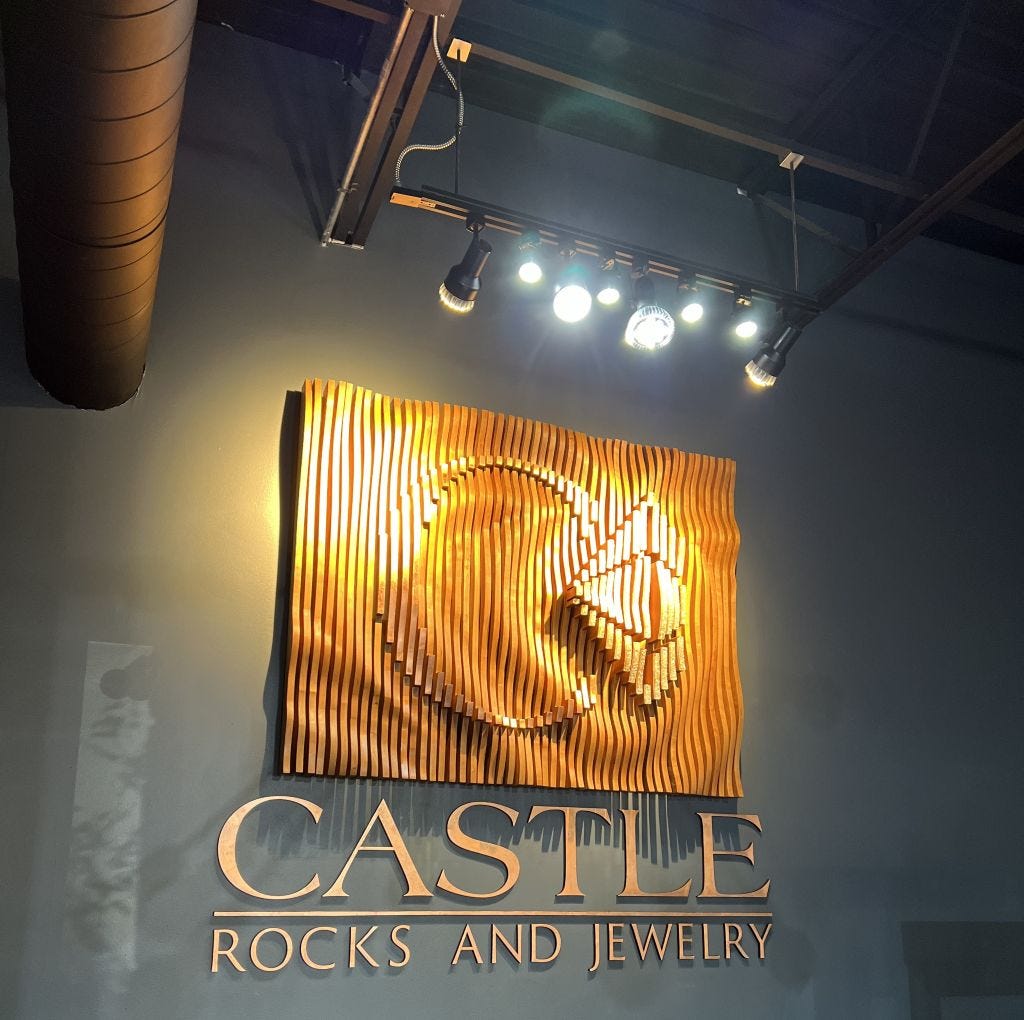
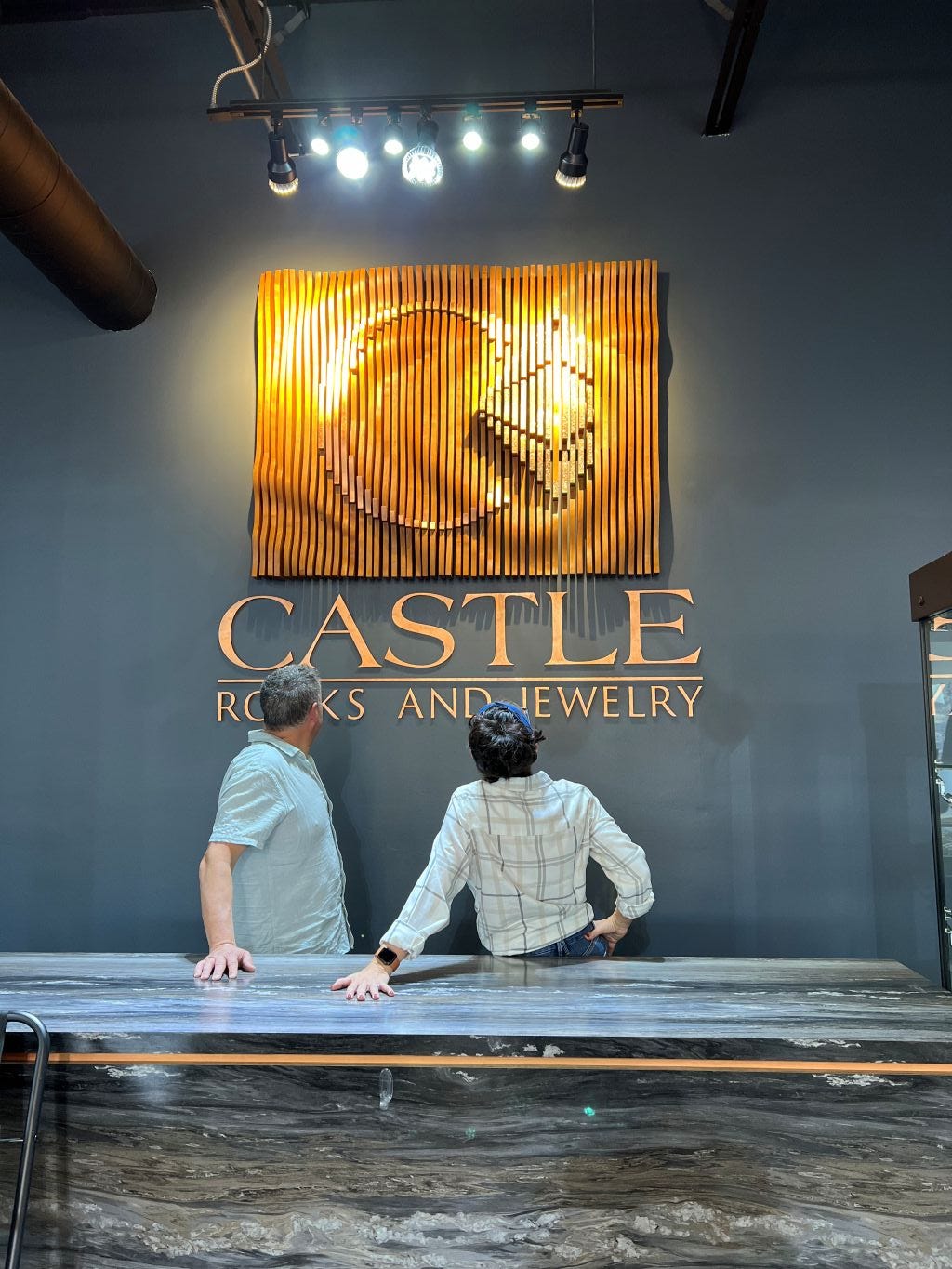
The owners of Castle Rocks and Jewelry, a husband and wife, had already approved the mockup. They knew something was going on the wall behind their counter. What they didn’t know was what I had in mind for the final piece. They only knew it would be made of solid cherry and would carry the logo one of them had designed.
When the owner who drew that logo walked into the store and saw the new signage, she wept. When something you make with your own mind and hands has that kind of impact on someone, the feeling stays with you for life.
Years earlier, she had drawn the ring and diamond logo. When they began planning new signage, she worried it might get lost.
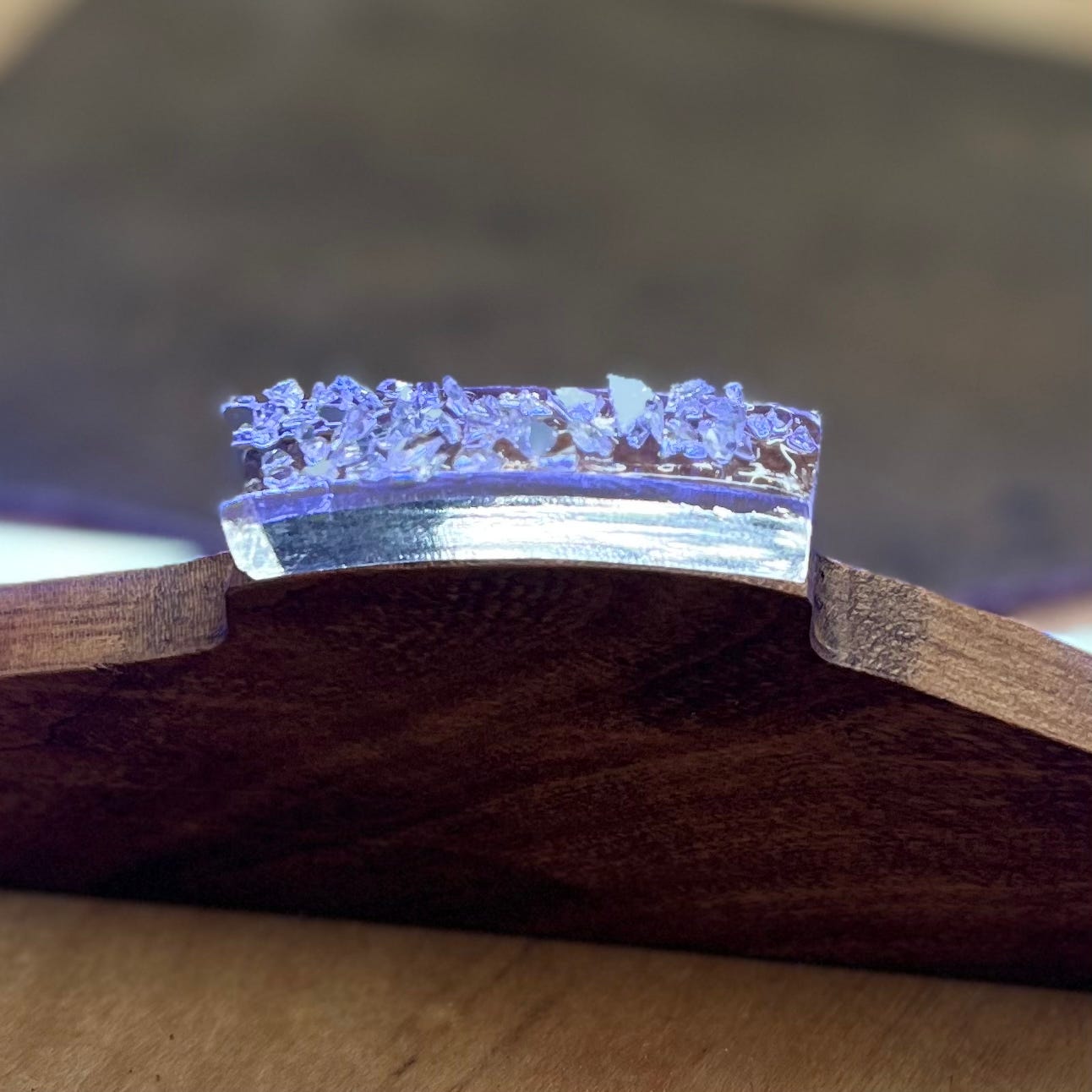
From the original paper sketch to digital mockup and final installation, that logo became the centerpiece of their store. Now it hung above the counter as a wall of vertical wooden slats, each one cut to a slightly different depth so that, together, they lifted the ring and diamond out of the wood. Chips of real crystal, set in resin, caught the light where the diamond sat. Hammered copper foil covered the ring and all the lettering.
Designing it was hard. Making it pushed me and those helping me harder than anything we had done in decades. I built the design in parametric modeling software; a system of sliders and curves that let me tune the depth of every facet. A computer-controlled (CNC) router cut the wood, and a laser cutter shaped the resin. When I stepped back from the finished wall, the thought in my head was simple: we made that. Then I watched what it meant to the people it was made for, and the pride gave way to something better.
Aside from the very analog pencil sketch, every tool in that chain was digital. The moment it produced was one of the most human experiences of my career. It is easy to miss how much that matters.
We are told, often and loudly, that technology is pulling us apart: screens replace faces, software replaces skill, and AI will finish the job, if not take the job. I understand the worry. But standing in that jewelry store, I saw something the warning misses. The question isn’t whether technology puts distance between us. It’s what technology lets us do for each other.
The prevailing story goes like this. We work from home and meet on screens. We scroll instead of talk. Now AI can answer our questions, keep us company, and hold a conversation at any hour, and the fear is that we will let it stand in for the people we should be reaching for.
That story gets some things right. Loneliness is real, and it is costly. Some technology is built to capture attention rather than serve the person holding the device. Anyone who has watched a restaurant full of people staring at their own screens knows the feeling of being together and apart at the same time.
Where the story goes wrong is in its measuring stick. It treats the form of a connection, in person and human to human, as proof of its worth. By that standard, a hollow conversation across a dinner table counts for more than a meaningful one across a video call, and a person who finds understanding through a machine has failed at being human. I don’t think that standard holds up.
If connection is what matters, then we should judge it by what it does for a person, not by who or what sits on the other end.
Most of us already live by that standard; we just don’t notice. Watch anyone with a dog or cat they love. Nobody tells them the bond is lesser because only one of them is human. My two dogs will never read the children’s book I wrote about them or understand my work, but when they tear through the snow after one another and come back to me covered in it, I feel as connected as I do with most people I know. We judge that bond by what it gives us, not by what species sits on the other end of the connection. If we can grant that to a dog, we can at least ask the question honestly about a machine.
Think of a widower who talks through his day each evening with an AI because the house has gone quiet. Think of remote collaborators who have never shared a room but trust each other completely. Think of someone who finds, online, the first community that has ever understood them. The mainstream view tends to treat each of these as a lesser substitute for the real thing. I would ask a different question: does the connection leave that person more understood, more capable, and less alone?
By that standard, the wall at Castle Rocks and Jewelry was not technology getting in the way of a human moment. It was technology extending my reach so I could expand someone’s dream, larger than they could have imagined it.
Much of the value we are worried about losing is already here. We just have to be willing to see it where it is, rather than where tradition says it should be. It’s hiding in plain sight.
I tested this standard on my own life before I ever wrote it down, at a time when distance was not a choice.
I have had COVID twice. The first time took me to the edge, and for a while I wasn’t sure I was coming back. During those years, distance from other people wasn’t a lifestyle problem. It was the price of staying alive. Even now, I carry wipes into the grocery store to clean the cart handles.
In 2021, I painted a single tree standing in still water, its leaves blazing orange against a cold blue lake and mountains. I called it Isolation. Looking at it now, I don’t see loneliness. I see something that stayed rooted and kept its color while everything around it went quiet.

What carried me through that time was not the absence of distance. It was what I did with it: I kept making things, kept learning, and kept reaching the people I love however I could. Today I tear up reading my children’s book manuscript out loud, and I well up watching our dogs play in the snow and chase rabbits. That isn’t someone who was diminished by distance. That is someone grateful to still be here for one more memory.
That resolve shows up in another painting from the same period, one built on fire and ice.

Sharing it online with friends kept me connected when I couldn’t be with them in person. It was a small thing, and it met every part of the standard I described earlier: it left me more understood, more capable, and less alone.
A rational argument has to face its strongest objections, so here are the three I take most seriously.
Reciprocity. Human connection involves being needed, not only being heard. An AI can respond well, but it doesn’t depend on you, miss you, or grow because of you. That is true, and it matters. But reciprocity has never been the only thing that gives a connection value. A book can change a life without needing its reader. A mentor can shape someone who never repays the debt. Mutual stakes make some connections richer; their absence doesn’t make every other connection worthless.
Measuring quality. If quality is the standard, who defines it? Feeling understood in the moment is not the same as being supported over years. This objection is fair, and it is the reason quality has to be judged over time, not in a single exchange. A connection that leaves someone more isolated a year later has failed the test, whatever it felt like at the time. The standard cuts both ways, and it applies to human relationships too.
Displacement. Even a good non-human connection might crowd out the harder human relationships people also need. This is the risk I worry about most, because the easiest connection is not always the one we need. I am reminded of this often: friendships take work, whether face to face or otherwise. An AI never gets tired of us, never disappoints us, and never asks anything in return. People do all three, and that friction is part of what makes human relationships worth having. The answer isn’t to reject the new forms of connection. It’s to use them the way I used a CNC machine: as a way to reach and connect deeply with people, not a way to avoid them. The warning sign is easy to state and hard to admit. When a tool that once helped you reach people becomes the reason you stop reaching for them, the connection has failed the quality test, however good it feels.
I think back to that store owners standing under their new sign. Nothing about that moment was less human because software designed the slats and a machine cut them. If anything, the tools made it possible for me to give them something I could never have made by hand in a reasonable amount of time.
So here is the shift I am asking for. Stop asking whether a connection is human enough and start asking whether it is good. Good connections are all around us, in forms we were taught not to count.
This publication exists to keep asking that question. In Plain Sight will look at AI with clear eyes: not to cheer it on, not to sound the alarm, but to see what is in plain sight, right in front of us.
Author’s Transparency Note
Every essay on In Plain Sight starts with a conversation. I bring the stories from my life, my experiences, the arguments I want to make, my outside research, and the questions I’m wrestling with. Claude, an AI model made by Anthropic, helps me shape those into a structure and writes a first draft. I then revise it: correcting facts, changing wording, adding detail, and cutting anything that doesn’t sound like me or isn’t true. The final essay is mine to stand behind, but much of the sentence-level writing began with Claude. I share this openly because a publication about seeing AI clearly should start by being clear about how it uses AI.
If this essay resonated with you, that may be the best evidence for its argument: what matters is the quality of a connection, not its form.
Thanks for reading ~ Cale Dansbee